Pair of North African Arm Daggers or Short Swords
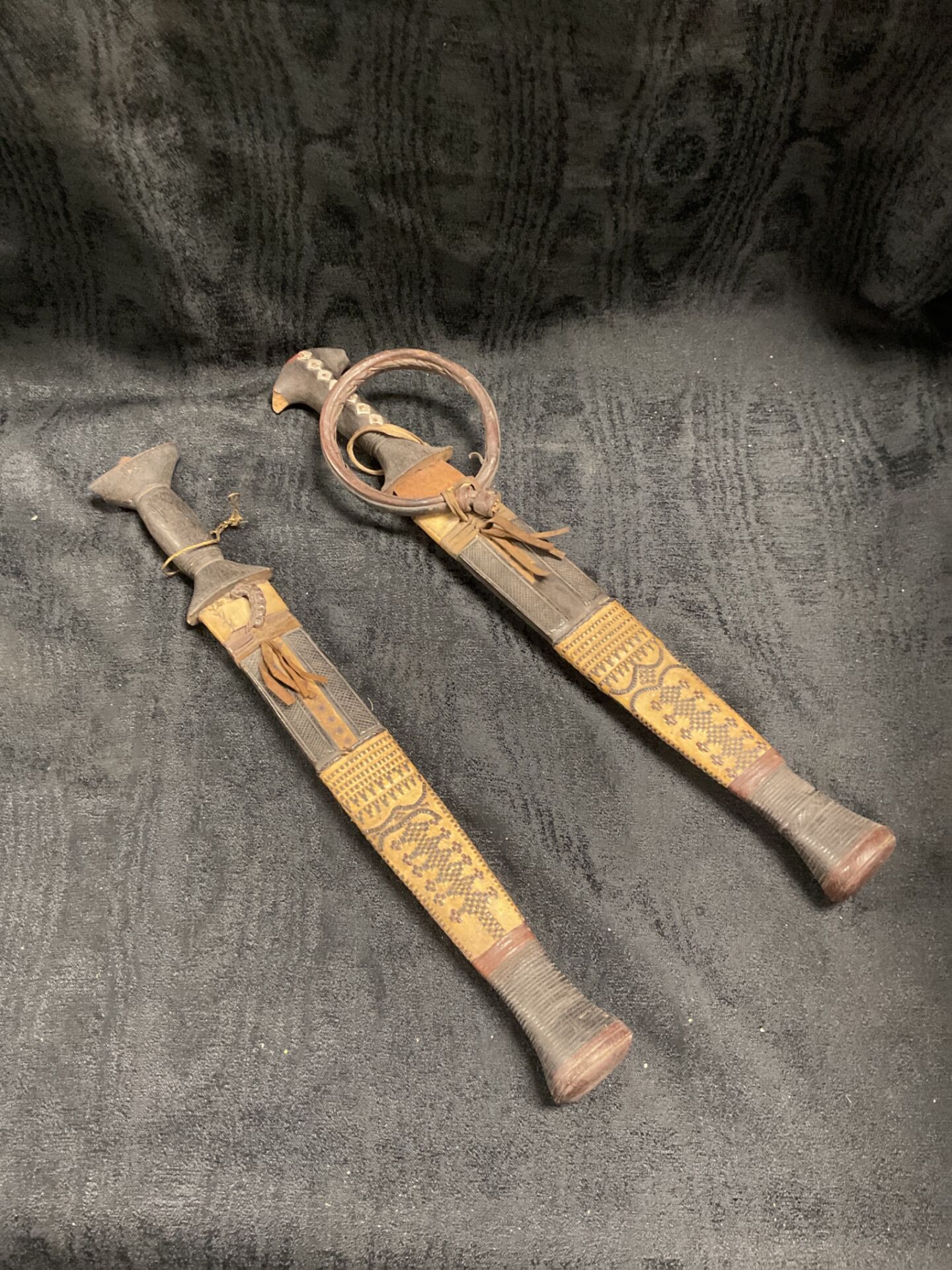
This lot comprises two North African arm daggers, or short swords, offered as a matched pair. The catalogue attribution is Hausa or Tuareg, with a possible Sudanese origin. Both examples are shown in their sheaths, so the blades are not visible and have not been examined. Each has a carved dark wooden hilt, one with a flared, bird-like finial and the other with a sculpted, tapering grip, both of which are typical of West and Central Saharan and Sahel metalwork and carving traditions.
The scabbards are the most striking feature. Each is covered in tooled and incised leather, decorated with geometric bands, zigzag and chevron motifs, and dotted or stepped borders. The leather has been worked into shades of ochre, tan and deep brown, and the chapes are finished with a ribbed, cylindrical terminal. The left-hand example has a leather strap and a loose cord tie at the throat. The right-hand example retains a metal ring, which may have been used for suspension or as an arm fitting, although its original function is not confirmed.
Condition and Collector Appeal
Both pairs show the expected age-related wear for pieces of this type. The leather scabbards display surface scuffing, drying, lifting at the edges and some dark staining, while the wooden hilts show handling marks and small areas of wear on their carved details. Ties and cords are present but fragile. Nothing has been restored or altered as far as can be determined from the photograph, but the condition should be assessed in person, as the internal fittings and blades are not visible. Buyers should expect a sensibly original, used appearance rather than a pristine one.
Pairs like these appeal to collectors of African arms, decorative tribal objects and Saharan material culture. The combination of carved hilts and richly decorated leather scabbards makes them attractive display pieces. Their original surface patina and distinctive regional character, together with the uncertainty surrounding their precise attribution, may also interest researchers and those who enjoy identifying and studying regional variations.